
America Can Build the Drone. But Can It Build Enough of Them?


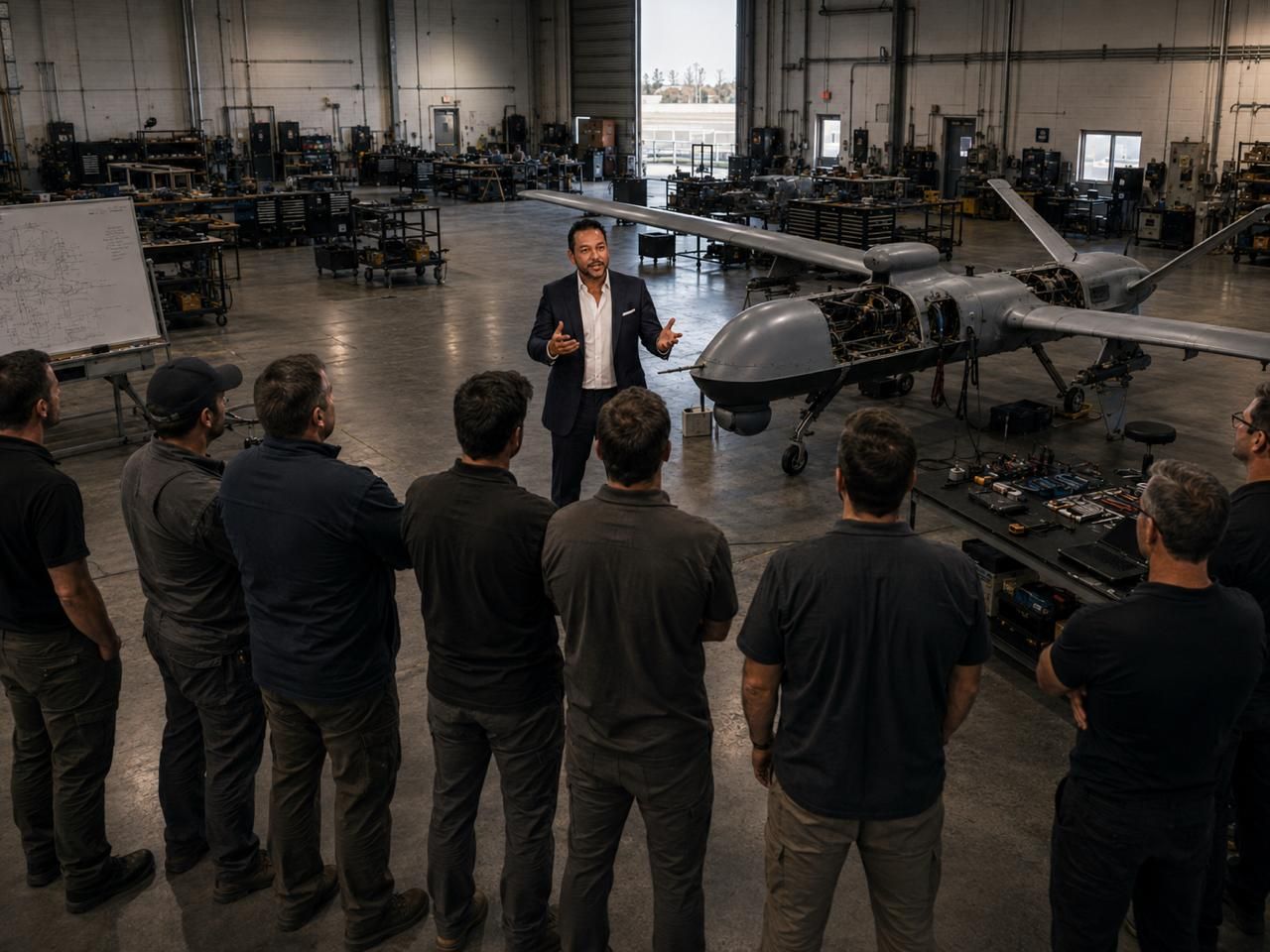
America Can Build the Drone. But Can It Build Enough of Them?
By Jessica Smith
America may possess the world’s most advanced drones, artificial intelligence, sensors and weapons—but what happens when an adversary can replace its losses faster than America can replace its victories?
That is the contradiction now confronting the United States.
Washington has spent decades building superior military technology. Iran has pursued a different strategy: produce less-expensive drones and missiles in sufficient numbers to force a far wealthier military into costly defensive decisions.
America may destroy the incoming drone.
But every interception consumes equipment, personnel, maintenance capacity and limited inventory.
The United States could win every engagement and still lose the industrial war.
The Open Drone Exposes the Real Battlefield
From the outside, a military drone looks like one finished product.
Open its body and a much larger dependency becomes visible: processors, sensors, communications hardware, wiring, motors, cameras, thermal systems and hundreds of specialized parts.
Each component begins somewhere else.
A mineral must be extracted.
A material must be refined.
A component must be manufactured.
An engineer must integrate it.
A technician must repair it.
A factory must be able to produce another one after the first aircraft is damaged, destroyed or consumed.
This means the real battlefield is not only in the sky.
It is inside mines, refineries, electronics plants, semiconductor facilities, machine shops and production lines.
Iran Does Not Need the Better Drone
Iran does not have to outperform every American system.
It only has to create enough threats to force America to respond repeatedly.
That creates an uncomfortable choice:
Should the United States use an expensive interceptor against a comparatively inexpensive drone?
Should commanders conserve limited defensive weapons and accept greater risk?
What happens if several regions require the same interceptors, components and production capacity simultaneously?
Iran’s objective does not have to be technological superiority.
Its objective can be industrial exhaustion.
A low-cost drone becomes strategically powerful when destroying it costs more than producing it.
Artificial Intelligence Cannot Manufacture Itself
The world talks constantly about AI-powered warfare.
But artificial intelligence cannot mine copper.
It cannot refine silver.
It cannot manufacture corrosion-resistant gold contacts, motors, sensors, circuit boards or replacement airframes without a physical industrial system behind it.
AI may operate the drone.
Materials and manufacturing make the drone possible.
That is why engineers gathered around an opened aircraft represent something more important than a technology demonstration. They represent whether a nation can understand, repair, reproduce and scale the machine.
A prototype proves that a country can invent.
Mass production proves that it can survive a prolonged conflict.
America’s Dangerous Assumption
America has often treated superior technology as the final answer.
But military superiority and military sustainability are not the same thing.
The most advanced weapon may not decide the next war.
The deciding factor may be:
which country can manufacture faster;
which country controls the necessary materials;
which country can repair systems locally;
which country has fewer foreign supply dependencies;
and which country can continue producing after existing inventories are depleted.
Money alone cannot solve this during a crisis.
Congress can authorize billions of dollars, but funding does not instantly create mines, processing facilities, engineers, qualified suppliers or functioning production lines.
Those capabilities must exist before the emergency begins.
The YVIRIS Position
YVIRIS sees the drone as the final stage of a much longer strategic chain:
Mineral origin. Processing. Refinement. Components. Manufacturing. Autonomous technology.
Countries that purchase only the finished aircraft remain dependent on the countries controlling everything beneath it.
Mineral-producing nations should therefore stop accepting a role limited to exporting raw material.
They can become strategic participants in processing, high-purity conversion, component production, advanced manufacturing and secure international supply chains.
The future of national security will not belong only to the country with the smartest autonomous system.
It may belong to the country capable of producing the acceptable system repeatedly, affordably and without asking a rival for the materials inside it.
The Question America Must Answer
America can build the drone.
But can it manufacture thousands of them?
Can it repair them under combat pressure?
Can it replace their components during a global supply disruption?
Can it defend against inexpensive enemy drones without exhausting expensive defensive systems?
Iran does not need to defeat American engineering.
It only needs to expose the limits of American production.
The next military superpower may not be the country with the best weapon—it may be the country that never runs out of them.
About
Edwin Dior Abreu
Chief Executive Officer, YVIRIS
Own the intelligence, not only the mineral